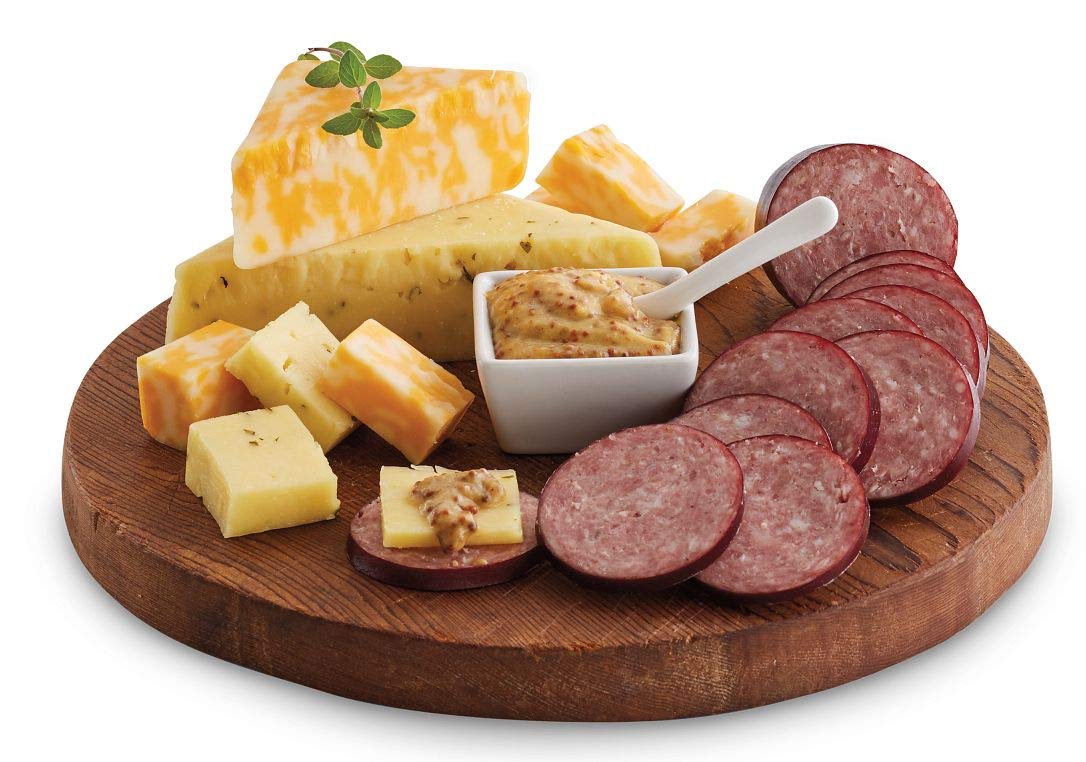
A meat and cheese gift basket — also called a charcuterie gift set — is exactly what it sounds like: a curated assortment of cured meats (think salami, prosciutto, or summer sausage), aged or specialty cheeses, and usually a handful of supporting items like crackers, mustard, or jam, all packaged together for gifting. The category spans an enormous price range, from $30 grocery-store tins to $150 artisan crates, and the difference in what you’re actually getting is not always obvious from the product photo. This guide is for buyers who’ve already sent a basket or two and are now asking the harder question: am I getting fair value, or am I paying $80 for a beautiful box containing $22 worth of food? We’ll walk through how to reverse-engineer cost per item, where the margin hides, and exactly which basket tier makes sense for which situation.
How to Read a Basket’s Real Value (The Per-Item Math)
The fastest way to evaluate any gift basket is to price each item individually at retail — a technique food writers at Wirecutter’s “Best Food Gifts” guide and Tasting Table’s 2025 meat-and-cheese roundup both use implicitly when they flag baskets as “good value” versus “paying for packaging.”
Here’s a simple framework:
Step 1 — Inventory the contents. Most reputable sellers (igourmet, Mouth.com, Williams Sonoma food gifts) publish a full item list. If they don’t, that’s a red flag.
Step 2 — Price each item at retail. Look up the standalone price of each component at a specialty grocer or direct from the producer. A 4 oz Busseto dry salami retails around $4–$5. A 3 oz wedge of aged Manchego runs $5–$7 at specialty retail. A sleeve of artisan crackers is $4–$6.
Step 3 — Compare against the basket price. A well-priced basket should carry a 20–35% premium over the sum of its parts — that spread covers curation, cold-pack shipping, and the gifting presentation. Beyond 35–40%, you’re largely paying for the box and the brand name on the lid.
Step 4 — Subtract the packaging premium. A branded wooden crate, magnetic-closure gift box, or branded ribbon accounts for $8–$20 in many mid-range baskets. That’s fine if the recipient will actually reuse it. It’s a waste if they won’t.
By the Numbers: Typical Item Costs vs. Basket Price
| Basket Price Point | Expected Food Value (at retail) | Acceptable Premium | Red-Flag Premium |
|---|---|---|---|
| $30–$50 | $18–$32 | Up to 35% | >50% |
| $55–$85 | $38–$58 | Up to 35% | >45% |
| $90–$150 | $65–$105 | Up to 30% | >40% |
| $150+ artisan | $110–$130 | Up to 35% | >45% |
At the $150+ tier, per Tasting Table’s 2025 analysis, the most defensible baskets tend to include genuinely hard-to-source items — a named-origin prosciutto di Parma (PDO-certified), a raw-milk cave-aged cheese, or a regional soppressata that isn’t available at major grocery chains. If the premium tier contains the same Hickory Farms-style summer sausage and gouda you could assemble at Costco for $28, the curation value is zero.
Where the Margin Hides: Four Common Value Traps
1. Filler Crackers and Jam Pads
Nearly every basket in the $40–$80 range uses crackers and jam to hit a respectable-looking item count without spending much. A 4 oz jar of fig jam retails for $3–$5. A sleeve of water crackers is $2–$4. These aren’t bad items — they’re genuinely useful on a tasting board — but when they make up 40% of the basket’s visual footprint and a meaningful chunk of the listed item count, you’re paying meat-and-cheese prices for pantry fillers.
The fix: count the protein items and cheese items separately from condiments and crackers. A basket with four distinct meats and two cheeses is delivering value. A basket with one 2 oz meat log, one cheese wedge, and seven filler items is not.
Serious Eats’ charcuterie overview by Sasha Marx notes that a well-built board should have at least a 2:1 ratio of cured meats to condiments by surface area — a useful mental model for evaluating whether a basket is skewed toward substance or staging.
2. Weight vs. Piece Count
Some sellers quote “12 items included!” while others quote “2.5 lbs of premium charcuterie.” Neither is inherently honest or dishonest — but they’re measuring different things, and sellers choose whichever framing flatters their offer.
A $65 basket with “12 items” might include 12 genuinely substantive pieces, or it might include 12 items averaging 1–1.5 oz each (less than half a pound of actual food). A $65 basket with “2 lbs of charcuterie and cheese” might be mostly rind and cracker by weight.
The most useful number is ounces of cured meat + ounces of cheese, stated plainly. igourmet’s product catalog is notably transparent on this, often breaking out individual weights per SKU. Food & Wine’s 2025 gift basket roundup specifically highlighted igourmet’s itemization practices as a model for consumer transparency.
3. Overnight Shipping Built Into the Price
Cold-pack perishable shipping — the insulated liner, gel packs, and overnight or 2-day delivery required for real charcuterie — costs sellers $15–$25 per order to execute. Many premium basket brands price that cost into the basket price itself, which is completely reasonable. But some sellers charge the basket price plus $18–$22 shipping on top.
When you compare a $70 basket with free shipping to a $55 basket plus $19 shipping, you’re comparing $70 to $74 — the cheaper option barely saves you anything, and the “free shipping” basket is actually the better-value signal (it implies the seller is confident enough in margin to absorb fulfillment costs).
Decision rule: Always calculate basket price + shipping before comparing options. Never compare sticker prices alone.
4. The “Artisan” Label Without Certification or Origin
“Artisan,” “gourmet,” “premium,” and “hand-selected” are unregulated marketing words in the U.S. food context. They cost nothing to print on a label. What does cost something — and signals genuine sourcing accountability — are protected designations of origin (PDO/DOP/AOC), named producer callouts (“from La Quercia in Iowa” or “Jasper Hill Farm, Vermont”), or third-party certifications (USDA Organic, non-GMO, American Cheesemakers Guild membership).
Wirecutter’s food gifts guide consistently notes that the most defensible premium baskets name their producers and regions explicitly, rather than relying on adjectives. If a basket description says “imported Italian-style salami” with no producer name, that’s a different product than “Felino salami from Emilia-Romagna, PDO-certified.” The price difference between these can be $3–$8 per item at retail — and it matters for the recipient who cares about provenance.
How to Match Basket Tier to Gifting Situation
This is where practitioners often over-index on quality without thinking about context. Not every gifting situation calls for a $120 artisan crate, and not every $35 basket is a compromise.
Client gifting, first relationship, unknown dietary profile ($45–$70 range): You want broad palatability, low allergen risk, and respectable presentation — not a confrontational funky cheese or a heavily spiced sopressata. Look for mild cheddar or gouda, a simple dry salami, honey or jam, and sturdy crackers. The goal is zero awkward reactions, not culinary adventure. A well-assembled basket in this range from a reliable retailer checks all those boxes without the risk of a raw-milk cheese arriving iffy after a shipping delay.
Tasting-night gift for a food-curious recipient who will appreciate provenance ($85–$130 range): This is where origin labeling and producer names pay off. Prioritize baskets that name their cheeses (a Vermont clothbound cheddar, a Spanish Manchego Reserva), include at least one genuinely artisan cured meat with a regional designation, and don’t pad with generic crackers. igourmet and Mouth.com curations at this tier tend to over-deliver relative to comparably priced department-store options, per Food & Wine’s 2025 roundup.
Office or team gift, 10+ recipients, per-unit budget under $25: At volume, the math changes entirely. Individual per-unit assembly from a wholesale-minded supplier beats premium single-basket pricing by 30–40%. Look for bulk charcuterie snack boards, pre-portioned duo packs, or subscription-style mixed sets where per-unit cost drops with quantity. This is where Goldbelly’s corporate gifting tiers and similar platforms offer genuine value transparency — they publish per-unit pricing explicitly for bulk orders.
Dietary-restricted recipient (gluten-free, halal, kosher): This is the one situation where the basket’s aesthetic value becomes secondary to certification accuracy. “Gluten-free crackers included” is not the same as a basket that is certified gluten-free throughout — the cured meats, the cheese wax coatings, and the shared-facility risks all matter. QualitySnack.com’s dietary certification guide (linked in the on-ramp content hub) covers the distinction between “made without gluten” and “certified gluten-free” in detail — it’s the most important read before you order for a celiac recipient. Similarly, halal and kosher designations require certification at the producer level; “no pork” is not the same as “halal-certified.”
The If-X-Then-Y Decision Rules
If you’re comparing two baskets at similar price points and can’t choose:
- If one names producers and regions and one doesn’t → choose the one that names producers. You’re paying for accountability.
- If the cheaper basket has higher protein oz per dollar → the premium on the expensive one is packaging, not food. Buy the cheaper basket and upgrade the presentation yourself.
- If shipping is charged separately and tips the total above a basket that includes shipping → the included-shipping basket is the real deal, even if the sticker price looks higher.
- If the recipient is dietary-restricted → certification language is non-negotiable. No certification, no order, regardless of how good the basket looks on paper.
- If you’re buying at volume (10+ units) for office or client gifting → per-unit economics beat single-basket curation every time. Run the per-unit math before committing to any premium single-basket vendor.
The core principle, per every serious food-gift analysis from Tasting Table to Wirecutter: the best basket is the one where the food justifies the price, not the photography. A beautiful box full of commodity cheese and generic summer sausage at $90 is a worse gift than a plainly packed $55 assortment with two genuinely interesting, named-origin items and transparent per-item weights.
Do the math before you hit purchase. The recipient remembers what it tasted like, not what the box looked like.