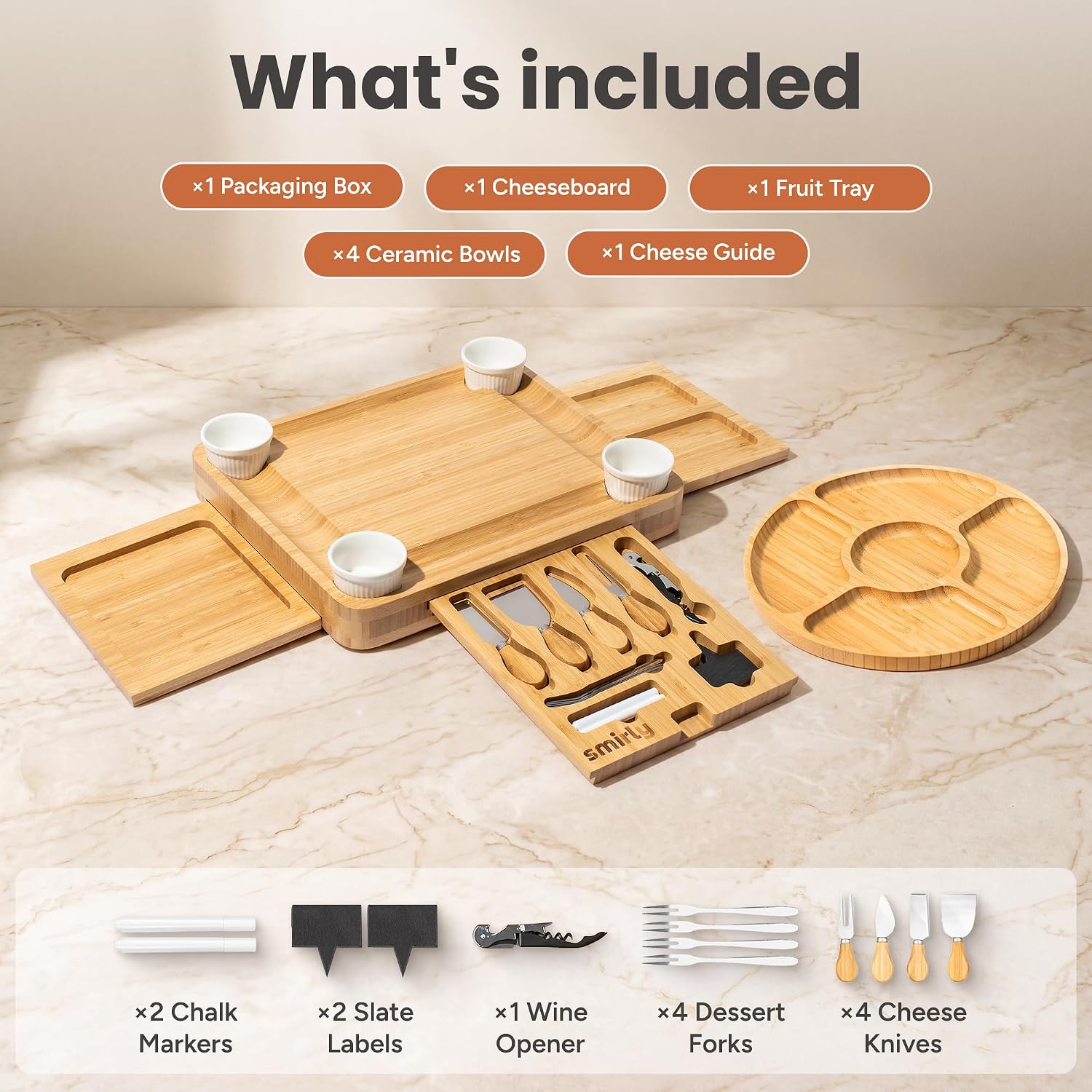
You don’t need to spend $80 on a bamboo board to put together a gift set that actually impresses someone. But you do need to know what separates the boards that last three years from the ones that split after two uses — and right now, with bamboo charcuterie board sets flooding the market in roughly the $25–$75 range, that distinction isn’t obvious from a product photo alone.
A quick level-set for anyone newer to this category: a charcuterie board is a flat serving surface — historically wood, increasingly bamboo — used to arrange cured meats (salami, prosciutto, coppa), cheeses, crackers, fruits, and accompaniments for a shareable spread. A gift set bundles the board with accessories: spreaders, cheese knives, small ceramic bowls called ramekins, and sometimes a carrying case or slate inserts. Bamboo is popular because it’s harder than most woods, resists knife scarring better than soft maple, and is technically a grass (making it a faster-renewable resource than hardwood). It’s also significantly cheaper to manufacture, which is both the appeal and the risk. This guide will show you exactly where that price gap matters — and where it doesn’t.
What the Price Tiers Actually Buy You
The bamboo charcuterie board gift set market in mid-2026 clusters into three distinct bands. Understanding what each tier actually delivers helps you stop shopping by sticker price and start shopping by use case.
$20–$35 (entry-tier sets): These typically include one board (usually 12–14 inches, single-layer bamboo laminate), two to four stainless cheese knives, and sometimes a small spreader. The board itself is functional but thin — typically 0.4–0.6 inches — and reviewers at The Spruce Eats consistently note that boards in this range show warp or surface cracking within 6–12 months of regular use, particularly when exposed to moisture from soft cheeses or washed frequently. For a one-time gift where longevity is secondary to presentation, this tier works. For anything the recipient will use weekly, it’s a false economy.
$40–$60 (mid-tier, the real decision zone): This is where the market gets genuinely interesting. Boards in this range tend to run 14–18 inches with thicker stock (0.75–1.0 inches), sometimes feature a groove channel around the perimeter to catch drips, and come with better-fit accessories — weighted knives, locking slate or marble inserts, and more substantial packaging. Across aggregated reviews, owners report that boards in this band hold up significantly better to regular use than entry sets, and the knife quality alone often justifies the $15–20 price jump over the entry tier.
$65–$85+ (premium bamboo sets): At this level you’re typically getting artisan-finished boards, engraving options (a meaningful differentiator for corporate gifting), full 6–8 piece knife and serving tool sets, and occasionally built-in drawer compartments for utensil storage. Food & Wine’s gift guide coverage of this tier notes that the value proposition here is largely experiential and presentational — the core board performance doesn’t improve dramatically over a solid mid-tier board, but the gifting moment is visually elevated. That matters when you’re buying for a client or a high-stakes occasion.
By the Numbers
| Price Range | Avg. Board Thickness | Accessories Included | Best Use Case |
|---|---|---|---|
| $20–$35 | 0.4–0.6 in | 2–4 knives, sometimes no spreader | One-time gifting, entry buyers |
| $40–$60 | 0.75–1.0 in | 4–6 piece knife set, drip groove | Regular home use, most gift scenarios |
| $65–$85+ | 1.0–1.25 in+ | 6–8 piece set, engraving, case | Corporate gifts, high-stakes occasions |
The Four Spec Variables That Actually Matter
Once you’ve anchored to a price tier, there are four variables worth evaluating in any specific set. This is where informed buyers separate good deals from overpriced ones.
1. Board thickness and lamination method. Bamboo boards are almost always laminated — strips of bamboo pressed together with adhesive. The key distinction reviewers at Serious Eats flag is edge-grain vs. flat-grain lamination. Edge-grain (strips oriented vertically) resists warping significantly better than flat-grain construction and handles moisture more gracefully. Manufacturers don’t always advertise this clearly, but it’s often visible in close-up product photos. When in doubt, owners consistently report that heavier boards — weight being a rough proxy for thickness and density — outlast lighter ones in the same price range.
2. Accessory quality, specifically knives. The knives that come with most bamboo gift sets are a mixed bag. Reviewers across Apartment Therapy and The Spruce Eats both note that the knife quality in entry sets tends to be the weakest element — thin blades, loose rivets, handles that don’t balance well. In the mid-tier, look for full-tang construction (where the metal runs all the way through the handle, visible as a line on the side of the handle) and at least partial stainless composition. This is one spec you can often confirm in the product listing’s detail photos.
3. Surface treatments and food safety. A bamboo board should be finished with food-safe mineral oil, beeswax, or a food-grade lacquer. This matters for two reasons: it affects how the board accepts (and holds) re-oiling for maintenance, and it determines whether the board is dishwasher-safe (almost none are, and listings that claim otherwise should be treated skeptically). Epicurious’s guide to charcuterie board care is explicit that bamboo should be hand-washed and re-oiled every 4–6 weeks under regular use — any gift set you recommend to someone should come with that instruction, either in the packaging or from you.
4. Packaging and presentation. This is uniquely important for gift sets, and it’s under-weighted in most review coverage. If the board ships in a plain brown box, the recipient’s unboxing experience is on you to supplement. Mid-to-premium sets that include a kraft-paper-lined box or a branded sleeve meaningfully reduce the gift-giver’s labor. For office pantry buyers or HR managers sending 20+ sets, this is a genuine operational consideration — you want a set that arrives ready to present, not one that requires re-boxing.
Pairing the Board With What Goes On It
Here’s the tradeoff that most bamboo board gift guides bury: the board is not the gift. The spread is the gift. A $45 board with a well-chosen $35 curated snack addition will land better than a $75 board shipped alone.
The practical question is what to pair with the board at different spend levels.
For $75–$100 total budget (board + provisions): a solid mid-tier board paired with a 4–6 oz selection of cured meats (a good Italian salami or a domestic coppa), two wedges of complementary cheese (a firm aged cheddar and a semi-soft like Gouda), a sleeve of artisan crackers, and a small jar of fig jam or whole-grain mustard. This hits all five flavor registers a charcuterie spread needs — fat, salt, acid, sweet, crunch — without requiring the recipient to do any assembly thinking.
For $150–$250 total budget (office or client gifting): this is where pairing with a curated provisions box from a source like igourmet or Mouth.com makes operational sense. The board provides the durable, rebrand-able centerpiece; the provisions box delivers the wow factor. Owners and gift-givers in this segment consistently report that the combination photographs better for social media and generates more recipient response than either component alone.
For $300+ per-set budget (premium corporate programs): at this level, engraved boards with company logos or personalized recipient names become the standard expectation. The board is a brand artifact, not just a serving surface. Food & Wine notes that engraving timelines for bamboo boards typically run 5–10 business days, a detail HR managers need to build into procurement calendars.
Common Traps and How to Avoid Them
The “antibacterial bamboo” overclaim. Some listings tout bamboo as naturally antibacterial. While bamboo does contain a naturally occurring antimicrobial agent called bamboo kun, Serious Eats and food safety researchers are clear that processed, laminated bamboo boards do not retain meaningful antimicrobial properties — the processing eliminates most of the benefit. Don’t let this claim drive a purchase decision.
Marble and slate insert boards at entry prices. Several sets in the $25–$40 range include marble or slate inserts alongside the bamboo board, which sounds like a value-add. In practice, reviewers note that budget-tier marble inserts are typically very thin (3–5mm), chip easily, and are often held in place by weak adhesive channels. A set that includes accessories at the expense of board quality is usually a bad trade.
Shipping damage risk for gift orders. Bamboo boards, especially thinner entry-tier models, are susceptible to corner damage in transit. If you’re ordering for a client or building a gift program, Apartment Therapy’s coverage of serveware gifting recommends ordering one test unit before placing bulk quantities. A board that arrives with a cracked corner is a worse impression than no board at all.
The Decision Rule
If you’re buying for a single recipient who will use this board regularly, spend $40–$60, prioritize board thickness and edge-grain construction over accessory count, and budget separately for provisions. The board is a long-term asset; the food is the immediate experience.
If you’re buying for office gifting at scale ($150–$500 per order range), go mid-tier board plus provisions box as a combination — it controls your per-unit cost while keeping the presentation quality high, and the operational lift of pre-packaged provisions saves real hours at volume. Engraved boards are worth the premium only if your timeline allows the 5–10 day lead.
If you’re buying a one-time gift at under $35 all-in, skip the board entirely and put the full budget into provisions. A beautifully assembled paper-wrapped provisions box from a curated source outperforms a cheap board every time. Come back to the board when the budget supports the mid-tier.
The bamboo board market has enough quality in the $40–$60 range that you don’t need to spend more to get something genuinely good. You just need to know which four variables to look at — and now you do.